
Automatic Driving Test Mistakes: 10 Common Faults and Simple Fixes
Most automatic driving test mistakes are small things that repeat. Learn what examiners look for, how the marking works and how to fix each fault before test day.
How the automatic driving test is marked
The practical test involves around 35 minutes of driving. It starts with an eyesight check and a “tell me” question, then you drive for about 20 minutes or more following a sat nav or road signs (this is called independent driving). You will also do one manoeuvre, such as parallel parking, bay parking or pulling up on the right and reversing.
The examiner marks you on a form with three types of fault, so it helps to know how automatic driving test mistakes are counted. The same rules apply whether you take the test in an automatic or a manual car. You can read the official outline on GOV.UK: what happens during the driving test.
Serious and dangerous faults are often called “majors”, and one is enough to fail. Minor (driving) faults are the small slips, and you can have up to 15. The catch is repetition: the same minor repeated can be marked serious, which is how many automatic driving test mistakes turn into a fail.
10 automatic driving test mistakes that make people fail
These automatic driving test mistakes match the faults that DVSA lists most often for failed tests. We have added what we see in automatic lessons and a quick fix for each.
1Weak observation at junctions
Most common
What goes wrong: You look too late, look once instead of checking both ways, or misjudge how fast a car, bike or scooter is coming. Others pull out at roundabouts when a car is close on the right.
Why automatics make it worse: Creep makes the car roll forward as soon as your foot lifts. Many learners are already moving before they have finished looking.
Fix: Approach slowly, keep your foot over the brake, and look right, left, then right again. If you are not sure, wait. Use the brake to hold the car still until the gap is clear.
Examiners also record: no effective observation at all, looking too late, misjudging the speed of an approaching vehicle, no checks when joining a dual carriageway, entering a roundabout with a vehicle close on your right, and going straight across a crossroads without looking.
2Not using mirrors before changing direction
What goes wrong: Learners forget the interior or wing mirror before turning, changing lane, or leaving a roundabout. The fault is not the mirror itself. It is that you cause another driver to slow down, swerve or stop.
Fix: Use the routine mirrors, signal, then manoeuvre, every time. Look in the mirror early, signal in good time and check your blind spot before any move sideways.
Examiners also record: causing another driver to slow when you change lane on a dual carriageway, and weak mirror use on or leaving a roundabout. If poor mirror checks lead to a near miss, it can be marked more seriously.
3Poor steering control
What goes wrong: Steering late when turning right into a side road, running wide on a bend, or clipping the kerb when pulling up. Crossing your arms can also lose you marks, because you may lose control of the wheel.
Fix: Learn pull-push steering and practise it until it feels natural. Slow right down before a turn, because the car steers better at lower speed. In an automatic you have more time to steer smoothly, since there is no clutch to manage.
Examiners also record: not steering enough on a bend, steering late into a side road on the right, repeatedly mounting the kerb when pulling up on the left, and steering late to pass parked cars.
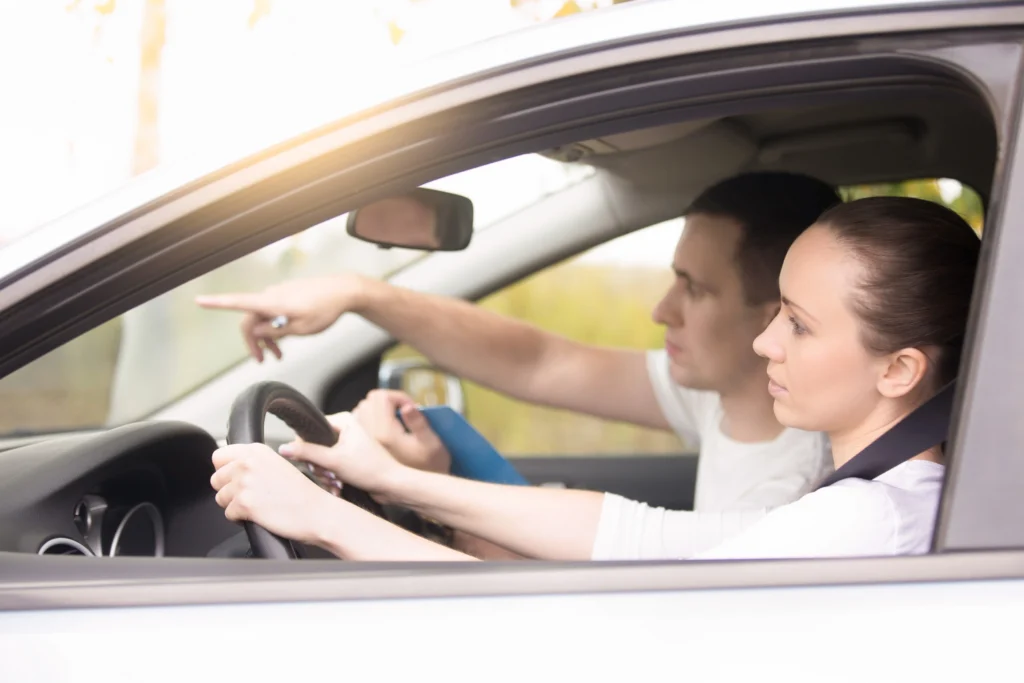
4Wrong position at junctions and roundabouts
What goes wrong: Cutting right corners, waiting too far left to turn right, taking the wrong lane on a roundabout, or driving straight across it instead of following the curve. Crossing the centre line while waiting to turn right is also a common fault.
Fix: Read road markings and arrows early. Choose your lane before you reach the junction. On roundabouts, follow your lane round and keep the same line until you leave.
Examiners also record: blocking traffic while you wait to turn right, using the left lane to turn right at a roundabout, and sitting left of the road when you should be positioned to turn right. Do not cross the centre line while waiting unless a filter lane or road markings allow it.
5Moving off unsafely
What goes wrong: No blind spot check, pulling out in front of a car, or moving away from behind a parked vehicle without a clear view. After an emergency stop, many forget to look all around again.
Why automatics make it worse: The car is ready to go the second you release the brake, so the check can feel rushed.
Fix: Select D with your foot on the brake, release the parking brake, then check mirrors and blind spots. Only then ease off the brake. Do not move until the check is finished.
Examiners also record: moving off from behind a parked car into the path of an approaching vehicle, repeated moves with no blind spot check, pulling away on the right so an oncoming driver slows or stops, and no rear checks after an emergency stop.
6Lights and traffic signals
What goes wrong: Going through on red, stopping on amber when it is safe to go, or hesitating on green. Learners also stop in the box for cyclists, or fail to move forward when turning right and the road is clear.
Fix: As you approach a green light, expect it to change and cover the brake. Stop for amber unless stopping would be unsafe. When a light turns green, check the junction is clear before you move.
Examiners also record: not reacting to red, not going on green when it is safe, going on green when the junction is not clear, stopping in the cyclist area, and not progressing when turning right and it is safe.
7Poor lane and kerb positioning
What goes wrong: Driving too close to the kerb, too near parked cars, or too near the centre line. Some learners sit in the right-hand lane of a dual carriageway for too long.
Fix: Aim to keep around a car-door width from parked cars. Look at the point far ahead rather than at the bonnet, and the car will follow your eyes.
Examiners also record: repeatedly driving too close to the kerb or centre line, sitting in the right-hand lane of a dual carriageway for no reason, and driving straight across a roundabout instead of following the curve of your lane.
8Missing signs and road markings
What goes wrong: Late reaction to a speed limit change, entering a bus lane, ignoring a no-entry sign, stopping on zig-zags, or crossing solid white lines.
Fix: Learn the common signs on your test routes and keep scanning ahead. Always check the speed limit when you move onto a new road. Driving far below the limit also counts as a fault if it holds up traffic.
Examiners also record: reacting late or not at all to speed limit changes, ignoring Stop or No Entry signs, and driving in a bus lane.
9Losing control when moving off or on hills
What goes wrong: Manual learners stall. Automatic learners tend to roll back on a hill, move off too quickly, or press the accelerator too hard for a smooth start.
Fix: On a slope, hold the car on the brake, release the parking brake when you are ready, then move to the accelerator smoothly. Practise on gentle hills first, then steeper ones.
Examiners also record: stalling and rolling back, repeated stalling, and moving off without selecting a gear. In an automatic, the equivalent is rolling back on a hill or moving off in the wrong gear.
10Reverse parking and manoeuvres
What goes wrong: Hitting the kerb, finishing far from the kerb, ending outside the bay, or not noticing traffic and pedestrians. Going too fast is the main cause.
Fix: Use creep. In an automatic, you can control reversing speed with the brake alone, which gives you more time to look and steer. Move slowly, look all around, and stop if anything appears behind you.
Examiners also record: ending with a wheel on the kerb after a parallel park, needing too many attempts to correct, finishing outside the bay, and not seeing approaching traffic or swinging out into the road.
More automatic driving test mistakes: people, bikes and road layout
The top 10 are not the whole story. These are the other places examiners mark you down, and they often show up on busy North London routes.
Zebra crossings
Creeping forward when someone is waiting, or stopping too late.
Fix: Slow early, cover the brake and stop if anyone is on or stepping onto the crossing.
Cycle boxes
Stopping inside the box at red lights.
Fix: Stop at the first white line. Only enter the box if the light changes when you are already across the line.
Filter arrows and one-way streets
Following the car in front into the wrong lane, or avoiding a lane because it is “the wrong one”.
Fix: Read the arrows and signs. In a one-way street you can use either lane, so pick the one for your exit.
Dual carriageways
Joining too slowly, or making traffic brake. Staying in the right lane too long.
Fix: Build speed on the slip road, check mirrors and blind spot, then merge. Return to the left lane when you can.
Bus lanes, zig-zags, hatched areas
Entering or stopping where you should not.
Fix: Check the times on bus lane signs and never stop on zig-zag or hatched markings.
Roundabouts
Going straight across, using the wrong lane, or pulling out with a car close on the right.
Fix: Pick your lane early, follow it round, and signal your exit.
Crossing the centre line to turn right
Waiting over the centre line blocks oncoming traffic and can be marked as a fault.
Fix: Position just right of centre in your own lane, without crossing the line, unless a filter lane or markings allow it.
Bikes and motorbikes at junctions
Bad judgement often starts with missing a cyclist or motorcyclist.
Fix: Look twice for narrow vehicles and wait if you are not sure the gap is safe.
Faults that mostly affect automatic learners
The marking is identical, but automatic cars create their own habits and their own automatic driving test mistakes. These are the ones we see most.
Pedal mix-ups
Using the left foot can press both pedals at once.
Fix: Right foot only. Left foot rests on the footrest.
Too much creep
The car moves as soon as the brake lifts, even at a junction.
Fix: Keep your foot on the brake until you are happy to go.
Wrong gear selected
Nerves can lead to D when you meant R, or the reverse.
Fix: Stop fully, look at the selector, then move it.
Parking brake missed
Forgetting to release or apply it, especially on electronic ones.
Fix: Learn the routine in your test car and say it aloud.
Harsh acceleration
A heavy foot makes the car lurch or kick down a gear.
Fix: Squeeze the accelerator rather than pressing it.
Coasting complacency
Easy driving can lower your guard on observation.
Fix: Treat every junction as if you were in a manual.
If you drive an automatic only, you will have Code 78 on your licence, so you can only drive automatic cars. Many learners choose this path because electric and hybrid cars are automatic anyway.
Highway Code changes that can cause automatic driving test mistakes
The January 2022 Highway Code update put more responsibility on drivers to look out for people walking and cycling. Examiners expect you to drive to the current Highway Code, so these points matter at junctions and crossings. Rules can be updated, so check the latest version before your test.
People crossing at junctions
When you turn into or out of a side road, give way to pedestrians who are crossing or waiting to cross.
Fix: Slow early, look into the road you are entering and wait if anyone steps out.
Cyclists going straight ahead
Do not cut across a cyclist who is going straight on when you turn at a junction.
Fix: Check your mirror and blind spot, and let the cyclist go first.
Passing cyclists
Leave at least 1.5 metres when passing a cyclist at up to 30mph, and more at higher speeds.
Fix: Wait behind if the gap is too tight. Never squeeze past.
Hierarchy of road users
Drivers of larger vehicles carry more responsibility for the safety of vulnerable road users.
Fix: Treat people walking, cycling and riding horses as your first priority at every junction.
Instant fails, and myths about automatic driving test mistakes
Here are real examples of faults that usually lead to a fail. The examiner always judges severity and context, so use this as a guide.
Myth: drive slowly and you will pass
Driving far below the limit or hesitating at safe gaps holds up traffic and is marked as a fault. Make steady progress.
Myth: one mistake fails you
No. You can make up to 15 minors. Stay calm and keep driving well.
Myth: crossing hands fails you
It is only marked if you lose control of the wheel. Pull-push steering is the safest habit.
Myth: neutral is fine for rolling
Selecting N to roll is coasting, and it reduces your control. Keep the car in D.
One more point: examiners normally carry on after a serious fault unless it is unsafe, so keep driving carefully to the end. Do not give up in your head after a mistake.
Will the examiner stop my test after automatic driving test mistakes?
Usually not. GOV.UK says the examiner will only stop the test if they think your driving is a danger to other road users. A serious fault does not end it by itself, so keep driving carefully to the end.
The main exception is the eyesight check. If you cannot read the number plate at the start, the test ends and counts as a fail. After any test you will get a driving test report showing the faults you made, so use it to plan your next lessons.
Your test day routine
Show me, tell me questions
You get two safety questions: a “tell me” before you set off and a “show me” while driving. A wrong answer is one minor fault. It only becomes serious or dangerous if you lose control of the car while showing the answer, such as taking your eyes off the road for too long.
- ✓Revise the full list on GOV.UK and practise it in your own car.
- ✓Find the controls for lights, wipers, demister and horn before test day.
- ✓Answer one question at a time. Look back at the road when you are done.
Nerves and the eyesight check
The test starts with reading a number plate at 20 metres. If you cannot, the test ends and it counts as a fail. Wear your glasses or lenses if you need them for driving.
Nerves are normal. Most examiners know that. To keep them under control:
- ✓Sleep well and eat before you go, since low energy increases mistakes.
- ✓Arrive early and take a short drive in the area beforehand if you can.
- ✓If you make a mistake, let it go. One minor does not end your test.
- ✓Breathe out slowly, then look further ahead. It settles both hands and mind.
Test routes and mock tests
Test routes are not published, so you cannot learn one by heart. Practise on a mix of roads instead. A mock test shows which automatic driving test mistakes you still make while you have lessons left to fix them.
- ✓Practise roundabouts, traffic lights, dual carriageways and one-way streets.
- ✓Do at least one mock test that includes independent driving with sat nav directions.
- ✓Write down the faults from each mock and fix one skill per lesson.
4-week plan to fix your automatic driving test mistakes
Short, regular practice works better than one long weekly drive. If you want to move faster, our intensive automatic driving course packs the same plan into a shorter time. If you are close to test day, our automatic driving test preparation includes mock tests that follow the real test format.
What to do if you fail
- ✓Ask the examiner to explain the faults, and read your feedback sheet carefully.
- ✓If you think the examiner broke the test rules, you can appeal. The window is short (check GOV.UK for the current time limit), and the result rarely changes, so most learners focus on retaking.
- ✓Book lessons on the exact skills that cost you marks.
- ✓You must wait at least 10 working days before your next test.
- ✓If you are nervous after a gap, book refresher lessons to rebuild confidence.
Many people pass on their second or third attempt. Learning from your automatic driving test mistakes is the fastest way to improve. A fail is feedback, not a verdict on how you drive.
Automatic driving lessons in North London
Practising on local roads helps most. Our instructors teach automatic learners across these areas, so you can train on the kind of junctions, roundabouts and busy roads you will meet on test day. Tap your area to see lesson details.
Ready to pass your automatic test?
Stop repeating automatic driving test mistakes. Train with patient North London instructors who teach in automatic cars every day. Get a mock test, clear feedback and a plan that fits your date.
Frequently asked questions
What is the most common reason to fail an automatic driving test?▾
Poor observation at junctions. Learners pull out without looking properly or judging the speed of approaching traffic. It is the top reason on both manual and automatic tests.
How many minor faults can I have and still pass?▾
Up to 15. Sixteen or more is a fail. One serious or dangerous fault is also a fail.
Can I fail my automatic test for stalling?▾
No, because automatic cars do not stall in the way manuals do. You can still get faults for poor control, such as rolling back on a hill or moving off too fast.
Do I fail if I get a show me tell me question wrong?▾
A wrong answer is one driving fault, not an automatic fail. A serious or dangerous fault only happens if you lose control of the car while answering.
How long must I wait to retake the test after failing?▾
You must wait at least 10 working days before your next practical test.
How many minor faults make a serious fault?▾
There is no set number. If the examiner sees the same minor fault repeated, they can mark it as a serious fault, which is a fail.
What happens if I make a mistake on the manoeuvre?▾
A small error, such as finishing a little far from the kerb, is usually a minor. Hitting the kerb hard, hitting an object or being unsafe is serious.
Is coasting a fault in an automatic car?▾
Yes. Selecting neutral to roll reduces control and can be marked as a fault. Leave the car in Drive.
Can I appeal my driving test result?▾
Only if you believe the examiner did not follow the test rules, and within a limited time. Appeals rarely change the result. Check GOV.UK for current rules.
Is the automatic test easier than the manual test?▾
The marking standard is the same. Automatic is easier to control, but you still need good observation, positioning and judgement to pass.
What will cause an instant fail on a driving test?▾
One serious or dangerous fault, such as pulling out so another driver must brake, going through a red light, or failing the eyesight check at the start.
What is an example of a serious fault?▾
Pulling out at a junction without proper observation so another road user has to slow down or swerve.
What are majors and minors?▾
“Majors” is the informal name for serious and dangerous faults, and one fails you. Minors are driving faults, and you can have up to 15.
Will the examiner stop my test if I make a fault?▾
Only if they think your driving is a danger to other road users. After a serious fault they normally let you carry on. If you fail the eyesight check, the test ends.
Do the Highway Code changes affect the driving test?▾
Yes. Examiners expect you to follow the current Highway Code, including giving way to people crossing and to cyclists going straight ahead at junctions.
Sources: GOV.UK driving test guidance and DVSA test information. Rules can change, so check GOV.UK before you book.