
How to Apply for a Provisional Driving License in the UK (Step-by-Step Guide)
By the Automatic Car Driving Course team | North London automatic driving instructors | Fees and rules last checked: November 2026
What Is a Provisional Driving License?
A provisional driving license is the first license every learner in Great Britain needs before they can legally drive on public roads with supervision. It shows the DVLA (Driver and Vehicle Licensing Agency) knows who you are, that you meet the basic eligibility rules and that you are allowed to learn. It is the green photocard that later gets swapped for a full license once you pass your practical test.
You need it for almost every step of learning to drive. Without it you cannot book a driving theory test, you cannot take a driving lesson, you cannot practise with a family member and you cannot book a practical test. Instructors check it at the start of your first lesson, so it is worth getting the application done early.
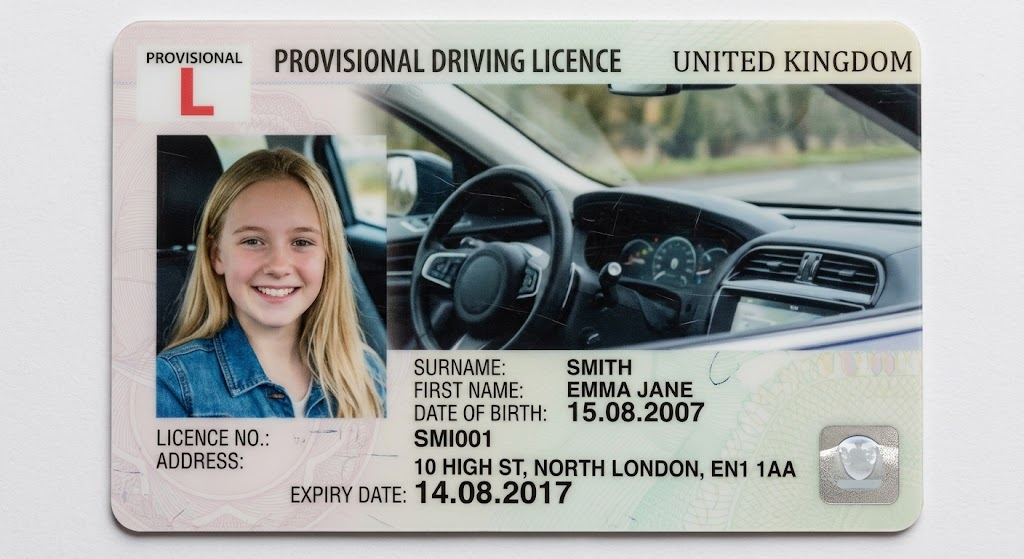
Does the same license cover automatic and manual cars?
Yes. A provisional license for a car does not say whether you will learn in a manual or an automatic. The choice only matters when you book your practical test. If you take your test in an automatic car and pass, your full license will carry code 78, which means you are restricted to automatic vehicles. If you pass in a manual, you can drive both. Many learners in North London choose automatic because it removes stalling and gear changes, so they can focus on road awareness in busy traffic. You can read more about that route on our automatic driving lessons page.
What Age Can You Apply for a Provisional License?
You can apply up to three months before your 17th birthday, which is at 15 years and 9 months. The license is issued early so that it is ready when you turn 17, but you must wait for your birthday before you drive on a public road. The exception is people who receive the enhanced rate of the mobility component of Personal Independence Payment (PIP), who can start driving a car from 16.
| Situation | Earliest you can apply | Earliest you can drive a car |
|---|---|---|
| Most learners | 15 years 9 months | 17th birthday |
| Enhanced rate mobility PIP | 15 years 9 months | 16th birthday |
| Already hold a moped or motorcycle provisional | No new application needed in most cases | 17th birthday for a car |
| Adult applying for the first time | Any time | As soon as the license arrives |
There is no upper age limit. Plenty of adults learn in their 30s, 40s and beyond, and the process is exactly the same.
Who Is Eligible to Apply?
You can apply online if you tick every box below. If one of them does not apply to you, the postal route or a phone call to the DVLA may be needed.
- You live in Great Britain (England, Scotland or Wales). Northern Ireland has its own separate service run by the DVA.
- You are old enough: 15 years and 9 months or over.
- You meet the eyesight standard (see below).
- You are not barred from driving for any reason.
- You have a valid form of identity.
- You can give your addresses for the last 3 years.
- You can pay the fee by debit or credit card.
You do not need to be a British citizen. People living in the UK on a visa or with a biometric residence permit can apply, as long as they can prove their identity and meet the residency rules.
The eyesight rule
You must be able to read a new-style number plate (one issued after September 2001) from 20 metres. That is roughly the length of five parked cars. This check is the very first thing the examiner asks you to do on test day, so it makes sense to try it before you apply. If you need glasses or contact lenses to meet the standard, you must wear them every time you drive. If you are unsure, book an optician appointment first. Many adults and some young people qualify for NHS-funded eye tests.
Health conditions
The application includes a short health question. Declaring a condition does not automatically stop you driving. Epilepsy, diabetes, some heart conditions and certain vision problems are examples that the DVLA may ask more about. Being honest is a legal duty, and giving the correct information at the start avoids delays and problems later.
Documents and Details You Need
Gather everything before you open the application. It takes around 10 to 15 minutes online if you are prepared.
| What | Details |
|---|---|
| Proof of identity | A valid UK passport is quickest because you only enter the number. Alternatives include a biometric residence permit (BRP), an EU or EEA national identity card, a travel document or a certificate of naturalisation. |
| National Insurance number | Asked for if you have one. If you do not know it, you can usually still apply. |
| Address history | Every address you have lived at in the last 3 years, in the UK or abroad, with approximate dates. |
| Payment card | A debit or credit card for the £34 online fee. |
| Photo and signature | If you use a UK passport the DVLA can use your passport photo and signature. Otherwise you will be told how to send them. |
Online or by Post: Which Is Better?
For nearly everyone the online route is better. It is cheaper, quicker and you get a confirmation email straight away. Postal applications use the D1 form, which is available from some Post Office branches or can be printed from GOV.UK.
| Online (GOV.UK) | By post (D1 form) | |
|---|---|---|
| Cost | £34 | £43 |
| Speed | Usually around a week | Often 2 to 3 weeks |
| Confirmation | Email straight away | None unless you use tracked post |
| Best for | Anyone with a passport and a card | People with no passport who cannot use the online service |
For postal applications, send the completed form to DVLA, Swansea. Always check the current address and fees on the official page before posting, as details can change.
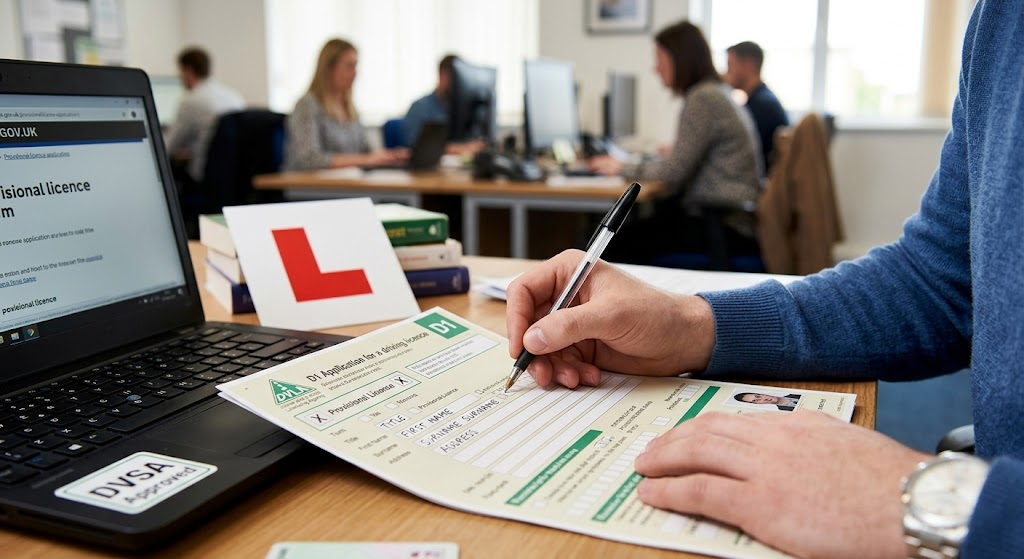
Step-by-Step: How to Apply Online
- Go to the official GOV.UK page. Search for “apply for your first provisional driving license” and use the page that ends in gov.uk. Avoid third-party sites that charge extra fees for the same form.
- Confirm you are eligible. Answer the age, residency and eyesight questions.
- Enter your personal details. Use your full legal name exactly as it appears on your ID, plus your date of birth and place of birth.
- Add your identity document. Enter the passport number or choose another accepted document.
- Enter your National Insurance number if you have one.
- List your addresses for the last 3 years. Do not leave gaps. If you lived abroad, include that address too.
- Answer the health questions. Be honest and complete.
- Check, pay and submit. Pay the £34 fee and keep the confirmation email.
Your license is posted to the address you entered. Make sure you will be there to receive it or that a family member can pick it up.
How Much Does It Cost and How Long Does It Take?
£34 online
The standard fee for a first provisional license applied for on GOV.UK.
£43 by post
The D1 paper route costs more and takes longer.
About 1 week
Typical online delivery. Allow up to 3 weeks for postal or extra checks.
10 years
The photocard stays valid for 10 years, so you will not need to renew it before your test.
If your license has not arrived after 3 weeks, contact the DVLA instead of reapplying, because a second application means paying twice. Replacing a lost or damaged provisional license has its own smaller fee. Please always confirm current prices on GOV.UK before you pay, as the DVLA can change them.
Common Mistakes That Delay Your Application
- Name mismatch. Using a nickname or a shortened name that does not match your passport.
- Address gaps. Missing a flat number or leaving months unexplained in your 3-year history.
- Wrong passport details. One mistyped digit can mean the DVLA cannot verify you automatically.
- Using an unofficial website. Some sites copy the DVLA design and add a service fee. The official service is on GOV.UK.
- Posting a copy instead of an original. For postal applications, copies are rejected.
- Not telling the DVLA about a medical condition. This can pause the application and is a legal issue.
- Wrong delivery address. Students and people who move often should double-check where the post will land.
Rules While You Hold a Provisional License
A provisional license is not permission to drive alone. Every learner must follow these rules until they pass the test.
Supervision
Drive with someone aged 21 or over who has held a full license for at least 3 years for the same type of car. They sit in the front passenger seat.
L plates
Display L plates on the front and back of the car (D plates are an option in Wales).
No motorways
Learners cannot normally use motorways, except with an approved instructor in a dual-controlled car.
Insurance
The car must be insured for a learner, whether you use a family car or an instructor’s car.
What to Do Once Your License Arrives
1. Check every detail
Read your name, date of birth and address carefully. Mistakes should be reported to the DVLA straight away, because the license number is used for your theory test and practical test bookings.
2. Book your theory test
You must pass the theory test, which includes multiple choice questions and a hazard perception test, before you can book the practical test. Book it through GOV.UK using your license number. Passing lasts for two years, so time it sensibly with your lessons.
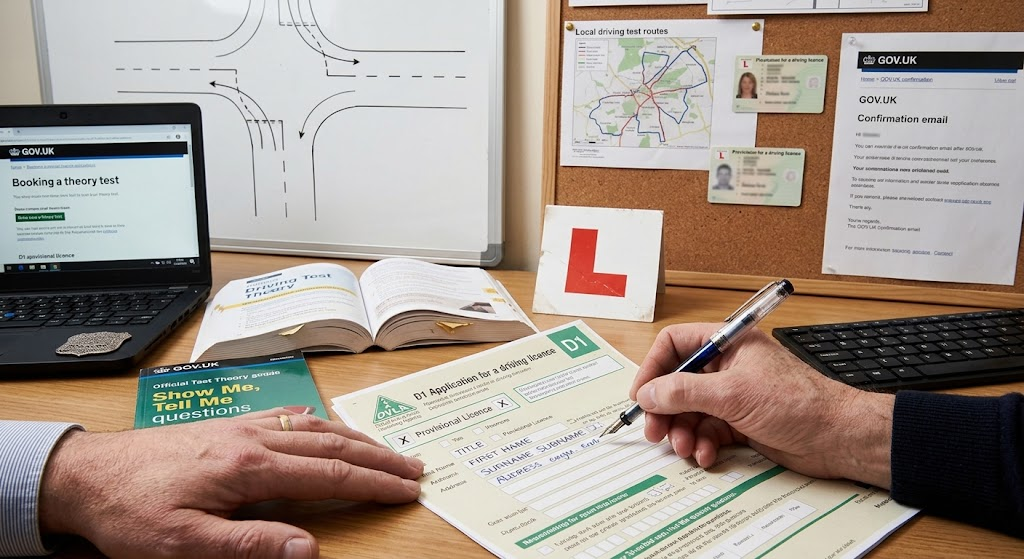
3. Start your driving lessons
Your instructor will ask to see the license at the first lesson. If you want to learn fast, an intensive automatic driving course can compress the learning into days or weeks. If you prefer to spread it out, weekly lessons are a steadier option. Both work well in automatic cars because there is no clutch control to master.
4. Sort learner insurance if you plan to practise privately
Family car practice needs the correct cover. Short-term learner policies or being added to the owner’s policy are common routes.
5. Plan your practical test
Book once your instructor says you are close to test standard. Our guide to common automatic driving test mistakes helps you avoid the faults that most often cost marks.
Why Many Learners Start With Automatic
A provisional license leaves the manual or automatic decision open, so it is worth deciding early. In an automatic you do not use a clutch or change gears, which means fewer things can go wrong in heavy traffic, on hill starts and at roundabouts. Learners can spend more attention on mirrors, hazards and positioning. Electric and hybrid cars are almost all automatic, so a license with code 78 suits the way the car market is moving. The trade-off is that an automatic-only license will not let you drive a manual car. If you know you will drive a manual car regularly, it may be better to learn in a manual.
Special Situations
Non-UK citizens
You can apply if you live in Great Britain and can prove your identity, for example with a BRP or a valid passport and visa.
No passport
Use another accepted document or the D1 postal form. The DVLA will advise on alternatives.
Lost license
Apply for a replacement through GOV.UK. A smaller replacement fee applies.
Name or address change
Tell the DVLA by updating your details online or by post. A new license is issued.
Foreign license holders
Some countries’ licenses can be exchanged or used for a limited time. Others cannot, so check the rules for your country.
Disability
Most disabilities do not prevent driving. The DVLA may assess your needs, and adapted cars are available.
Provisional License vs Full License: What Changes After You Pass
Many learners are not sure how a provisional license differs from the full license they receive later. The provisional license is a learning permit. It lets you build skills under supervision, while the full license gives you the freedom to drive independently. The restrictions on a provisional license end the moment you pass your practical test, even before the full license arrives in the post. Here is how they compare.
| Feature | Provisional license | Full license |
|---|---|---|
| Supervision | Must drive with a qualified supervisor aged 21+ | Can drive alone |
| L plates | Required on the front and back | Not needed |
| Motorways | Only with an approved instructor in a dual-controlled car | Allowed once you pass |
| Passenger rules | Supervisor in the front seat | No supervisor needed |
| Validity | Photocard valid for 10 years | Photocard valid for 10 years, then renew |
| Automatic restriction | Not shown on the provisional | Code 78 if you passed in an automatic |
Because the license you get after an automatic test is limited to automatic cars, it is worth thinking about the type of car you want to drive for the next few years. Most new drivers in towns and cities are comfortable with that, especially as electric and hybrid cars grow more popular.
Quick Checklist Before You Apply
- ✓ I am at least 15 years and 9 months old.
- ✓ I have a valid passport or another accepted ID document.
- ✓ I know my National Insurance number, or I can apply without it.
- ✓ I have a list of my addresses for the last 3 years with no gaps.
- ✓ I can read a number plate from 20 metres, with glasses or lenses if needed.
- ✓ I have a debit or credit card for the £34 online fee.
- ✓ I will be home to receive the license when it is posted.
- ✓ I am applying on the official GOV.UK website only.
Advice for Parents and Guardians
If your child is about to turn 17, helping them apply early is a good idea, because it means the license is waiting when they are ready to start. The application must be in the learner’s own name and the declarations, including the health questions, are their own responsibility, so sit with them while they complete it. Help them gather the passport, address history and card, and check the name matches the ID exactly. Once the license arrives, store it safely, as it will be needed for the first lesson and for every test booking.
Parents also often ask when to start lessons. A sensible plan is to apply about three months before the 17th birthday, book the theory test once the license arrives and arrange lessons to begin soon after the birthday. This keeps momentum going and means your child is not waiting weeks for paperwork.
How Long Should You Wait Before Starting Lessons?
There is no minimum waiting time once you have the license. Some learners begin lessons within days, while others take a month to study theory first. What matters is that you are ready to commit regularly, because gaps between lessons slow progress. If you are short on time, a structured plan with a fixed number of weekly lessons or a short intensive course keeps your skills fresh and your costs predictable. Our instructors can talk through your timeline and recommend a realistic number of hours based on your confidence and any previous experience.
Applying Safely: Avoid Scams and Overcharging
Searching online can bring up sites that look official and charge £60 or more to “process” the same form. The only official fee is the one set by the DVLA. Check that the web address ends with gov.uk and that you are paying £34. You can begin the process at the official GOV.UK provisional license application page. Never share your passport details or payment information on websites you do not trust.
Provisional Driving License FAQs
How old do I have to be to apply for a provisional license?
You can apply from 15 years and 9 months old. You cannot drive a car on the road until your 17th birthday, or 16 if you receive the enhanced rate mobility component of PIP.
How much does a provisional license cost?
It costs £34 online and £43 by post. Always confirm the current fee on GOV.UK before paying.
How long does a provisional license take to arrive?
Online applications usually arrive in about a week. Postal applications or ones that need extra checks can take up to 3 weeks.
Can I take driving lessons before my license arrives?
No. You must have the physical license before any driving lesson, as your instructor needs to see it.
Do I need a different provisional license for automatic cars?
No. The same license covers manual and automatic. The difference appears only on your full license after you pass your test.
What documents do I need to apply?
Proof of identity (a UK passport is easiest), your National Insurance number if you have one, your addresses for the last 3 years and a payment card.
Can I apply without a passport?
Yes. You can use another accepted document, such as a biometric residence permit, or apply by post with the D1 form.
How long is a provisional license valid?
The photocard is valid for 10 years. Your driving entitlement runs to age 70.
Can I drive on a motorway with a provisional license?
Not on your own or with a family member. You can only use a motorway with an approved driving instructor in a car with dual controls.
What happens if I lose my provisional license?
Apply for a replacement through GOV.UK and pay the replacement fee. Tell your instructor if you have lessons booked.
Got Your License? Start Learning in an Automatic Car
Our friendly, DVSA-approved instructors teach calm, confidence-building automatic lessons across North London, including Enfield, Barnet, Southgate, Palmers Green and Cockfosters. Whether you want weekly lessons or a fast intensive course, we will build a plan around your timeline.
Book Automatic Lessons Check Areas We CoverThis guide is for information only. Fees, ages and rules are set by the DVLA and can change, so confirm the latest details on GOV.UK before you apply.